Wednesday, April 22, 2015

Karpman Drama Triangle


A colleague of mine asked that I write up an explanation of a model I shared in class which I had at first known as the "Triangle of Conflict" in which people have the tendency of falling into three roles: The Villain, The Hero, and the Victim. Her interest sparked my own quick research on the topic and found out it's originally known as Karpman's Drama Triangle from Games People Play, a book utilizing Transactional Analysis (which I love to use). Here's what I wound up writing up for her:

The model has many ways it can be adapted for use in psychotherapy. It's originally called the Karpman Drama Triangle and is a "game" in Transactional Analysis. The original roles are Persecutor, Victim, Rescuer but I have the tendency of using teen-friendly terms and Villain, Victim, and Hero are easy to relate to.

Karpman views all three as being unhelpful roles that increase drama. The persecutor The victim believes self to be helpless and asks to be rescued and overlooks ways to help themself. The persecutor tries to make everyone else wrong. The rescuer acts out of wanting to be needed. (think co-dependent relationship between victim and rescuer).

Drama persists when you merely switch roles instead of leave the triangle altogether. A persecutor/villain/bully who is suddenly told they are the one who's wrong may suddenly switch to victim. Or a rescuer become a persecutor by trying to correct everyone else.


I like to frame it as each role has pros and cons. The Victim gets someone to care for them and meet their needs but is also vulnerable. The Persecutor has power but no one cares for them. The Hero gets to save the day but doesn't get to address their own needs.

You can use this as psycho-education, you could use gestalt and have a person talk with their inner victim, villain, hero. You could have a group role-play the different parts.

Imagine someone who survives abuse. Often you'll see that person settle into the role of victim and potentially form a co-dependent relationship with either a villain or a hero or they may try to prevent themselves from ever becoming a victim again and then either bully others or constantly try to rescue others.

One person can go round and round the triangle. An abuser strikes their partner (persecutor); Look what you made me do! (Victim); Pulls partner in close and says, there there, it's alright. (moving from victim to rescuer). If you didn't _____ then I would never have done that. (back to persecutor)

Wednesday, April 15, 2015

Principles/Values of Therapeutic Communities


About a month ago, my supervisor at Odyssey House (a residential treatment facility utilizing therapeutic milieu) requested that we as Support Staff come up with ideas on how we might be able to revamp the rules and/or find a way to more uniformly enforce the rules so that there could be more consistency from shift to shift. The problem that has arisen is that rules are often enforced based on the personal interpretation of the staff on shift. This varies widely however due to differences in experience and personality which can lead to a great deal of tension among residents. As I contemplated this I thought about utilizing a collaborative process to construct a core set of Principles or Values that everyone can agree on and rely on when evaluating rules and enforcement of these rules.

Ideally this would be a process involving all clients and staff. To get the ball rolling I thought I'd come up with my own list which I think would likely be helpful in any therapeutic milieu.

Responsibility
Self-Control
Safety & Health
Awareness
Compassion
Respect

My (brief) reasoning:

Responsibility includes recognizing Consequences and Accountability
Self-Control involves Self-efficacy, and Behavior management
Safety & Health promotes security and peace for everyone.
Awareness promotes insight, understanding, and knowledge
Compassion balances out responsibility and control with Human Connection and Healing.
Respect promotes mutual support, dignity, and harmony.

I believe these are essential components to a therapeutic community. If we find that we are taking an action that can not be linked to one of these principles then it should be a clear signal that we should either re-think the action or re-think the principles and values.

Monday, May 26, 2014

Gestalt Therapy Integrated - Chapter 1

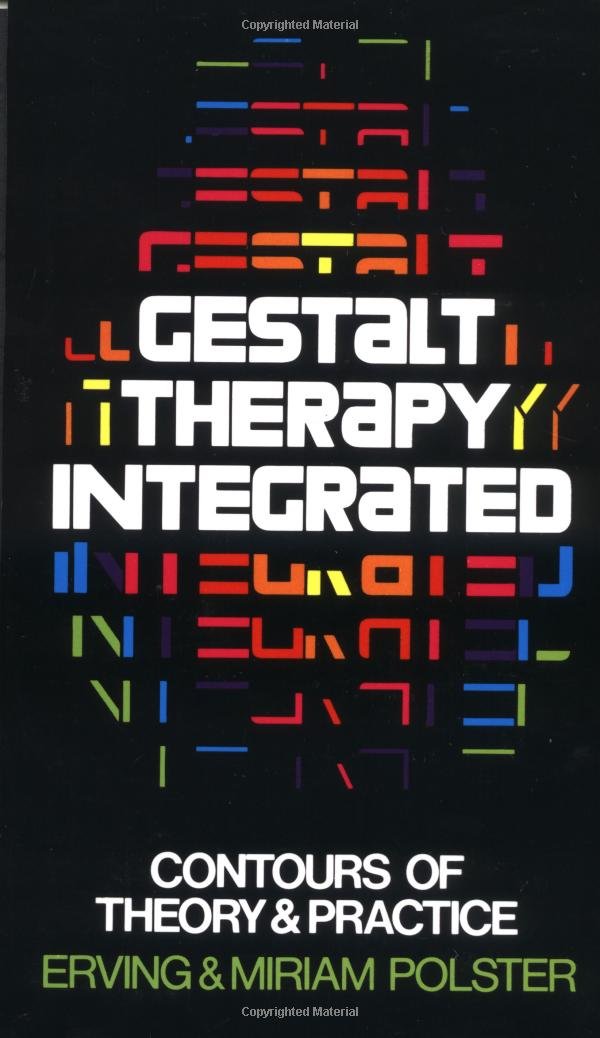
Gestalt Therapy Integrated: Contours of Theory and Practice by Erving & Miriam Polster

Chapter 1: The Now Ethos

The foundations of Gestalt Therapy are: "1) power is in the present; 2) experience counts most; 3) the therapist is his own instrument; and 4) therapy is too good to be limited to the sick." (Polster 1973, pg 7)

Power is in the Present 

“Two basic paradoxes obscure the dynamics of the present as the preordinate power base of life. The first paradox is that gestalt therapy recognizes the acts of remembering and planning as present functions even though they refer to the past and future. The second paradox is that we also deal with topics which are about concerns which extend beyond the scope of direct interpersonal confrontation and refer to many authentically important issues.” (Polster 1973, pg 7)
Even when we work to understand the origin of behaviors (psychoanalytic work) we still need to bring it to the present experience otherwise you are working with a person that no longer exists. Our past selves inform us about the present but our past selves are not who we are anymore.

Experience Counts Most

“Frequently learning itself is not even presented as an act of living in its own right. Real living is to begin at some time in the future -- after we finish college, after we get married, after the kids grow up or, for some, after we finish therapy” (Polster 1973, pg. 2)
I taught in public education for a few years and I am alarmed at the way some people treat education as simply presenting information and waiting for the other to be able to repeat it back to you. The process of learning is often far more important than the content. When I try to teach life skills and DBT-based skills to clients I worry when the client “says” what the skill is and then stops. Take I-statements for example. The concept is fairly simple. Word things from your own perspective and your own experience by using “I”. Rather than “You are so rude, “ you say, “I feel offended when you say _____.” It’s relatively easy to teach this skill but until it is processed it isn’t really an experience. Without experiencing something you can’t really internalize the importance or impact of the skill.

The Therapist is His Own Instrument

“When the therapist enters himself… he becomes not only a responder and a feedback giver, but also an artistic participant in the creation of new life. He is more than a catalyst which, though affecting chemical transformation, does not itself change. The therapist does change; he becomes more open to the range of experiences which he can know first hand, discovering with the patient what it is like to engage in the many ways which become open to them.” (Polster 1973, pg 20)
This concept simultaneously comforts and frightens me. I am comforted by the idea that I don’t need special tools in order to be an effective instrument. It frightens me because I don’t have much confidence in myself. If I imagine myself as my own instrument I worry that I am inadequate for the job. Wording the experience of being a therapist as being an “artisitic participant,” however makes the entire process far more approachable for me. If I can shift my paradigm from the point of view -- that the Therapist is the stable well-adjusted role model providing the answers to the client to the view that the therapist is a helper along the client’s journey and gets to journey with that client -- then perhaps I can be more comfortable in my own imperfection.

Therapy is too good to be limited to the sick


Therapy has become stigmatizing and I believe that’s a disservice to society. I think everyone could use a bit of therapeutic help and I also believe that we all receive therapy in one form or another. As an artist I am familiar with the power of self-exploration and with the expression and processing of thoughts and emotions. I can not quite imagine what my life would have been like without the therapeutic power of art. I would have had to find an alternative method to express and process which very well may have been going to therapy.

References

Polster, E., & Polster, M. (1973). Gestalt therapy integrated; contours of theory and practice,. New York: Brunner/Mazel.

Monday, May 19, 2014

Gestalt Therapy Integrated


Gestalt Therapy Integrated: Contours of Theory & Practice by Erving & Miriam Polster


http://amzn.com/0394710061

APA Citation:

Polster, E., & Polster, M. (1973). Gestalt therapy integrated; contours of theory and practice,. New York: Brunner/Mazel.

I picked this up at the Salt Lake City Main Downtown Library last week and have just started reading it. I have heard of Gestalt Therapy but haven't quite gotten to understand what the heck it is. I know it deals with the here-and-now, with experiential and existential work, and with the idea of working toward being a whole person and taking personal responsibility for that work. This all seems very vague to me, however, and I hope that this book will help clear some of that up for me.

Monday, May 12, 2014

Beginning

My name is James Dinh. I have just completed my first year of graduate school at the University of Utah studying Social Work. It's now the Summer and I sadly didn't have the funds to do Summer courses but I am determined to stay mentally active and continue to study through the break. Since I know I do better when I am actively producing something in a structured manner I have decided to create this blog to post my notes and thoughts on the things I am studying. I hope that I will be able to look back on this blog and be able to reflect on my progress as someone becoming a social worker.